The Real Atonement


The Real Atonement

Thinker: So, what is your thinking on the atonement of Christ?

True Believer: I believe he died for my sins and through the shedding of his blood I am saved.

Thinker: And what have you done to be saved?

True Believer: I believe on Him and accept the gift he has given me.

Thinker: And what are you saved from?

True Believer: My sins.

Thinker: All your sins or part of them?

True Believer: All of them, of course.

Thinker: Are you saved now?

True Believer: Yes, I’m saved through the blood of Jesus.

Thinker: Does this mean that your past sins will be as if they never happened?

True Believer: Yes.

Thinker: Theft is a sin, is it not?

True Believer: Yes. The scripture says, “Thou shalt not steal.”

Thinker: Let us suppose that before you were saved you robbed a guy on the street of his money that was going to pay for an operation to save his daughter’s life. Without the money the kid dies but shortly thereafter you find Jesus and get saved. Is the kid still dead?

True Believer: Of course.

Thinker: So, even though you are now saved, your sin still has a terrible effect and the father hates your guts. Sounds like your sin still has an effect even though you accept Jesus.

True Believer: Well, I suppose our sins have a residual effect in this world, but when we accept the atonement we have a clean slate in God’s eyes for the next world.

Thinker: So, even though you are saved, your sins have an effect in this world but none in the next.

True Believer: Yes.

Thinker: Let us suppose that the sick girl was not saved when she died but was on the verge of it and would have found Jesus if she had lived. Because of your sin then she goes to hell instead of heaven. Does that sound like your sin will have no effect in the next world?

True Believer: There’s no way to tell if she would have been saved.

Thinker: We do know that a lot of kids do eventually accept Christ. That is a fact and in our example we are talking about one of these. Now, let us place ourselves in the kid’s position after death. There she is suffering in hell with the realization that she was going to turn her life around if she had lived, but this didn’t happen because of you. She curses your name even as you are enjoying bliss with Jesus. Does that sound like your sin has no effect in the next world?

True Believer: God will take away the memory of my sins so I will not be affected by anyone in hell.

Thinker: Where does it say that in the Bible?

True Believer: I’m not sure. It’s in there somewhere.

Thinker: Wrong. It’s not in there. And even if this strange idea were true it would be pretty cold hearted to ignore the eternal suffering of a child, by blotting out the memory, when that suffering was your fault. Don’t you agree?

True Believer: God’s ways are not man’s ways. If we could understand God then it would all make sense. We can’t use the reasoning of this world.

Thinker: But it sounds like you are using the reasoning from your mind in this world to make sense of the atonement. What makes you think that reasoning from your thinking in this world is correct?

True Believer: That’s what faith is all about.

Thinker: So your faith is based on the reasoning of this world?

True Believer: You’re twisting things. My faith is based on the Bible, the Word of God.

Thinker: And what makes you think you understand it since you have to use your worldly mind to read it?

True Believer: The Bible is clear. I just accept what it says.

Thinker: Let’s see if you accept this:

“But let every man prove his own work, and then shall he have rejoicing in himself alone, and not in another. For every man shall bear his own burden. Let him that is taught in the word communicate unto him that teacheth in all good things. Be not deceived; God is not mocked: for whatsoever a man soweth, that shall he also reap.” Gal 6:4-7

Would you read verse five for me?

True Believer: “For every man shall bear his own burden.”

Thinker: Does that sound like Jesus is going to negate the effects of our mistakes or sins?

True Believer: You’re taking things out of context.

Thinker: But the context continues in verse seven. Read that.

True Believer: “Be not deceived; God is not mocked: for whatsoever a man soweth, that shall he also reap.”

Thinker: So, even though you have found Jesus this does not negate the fact that you robbed a guy and caused his daughter to die and go to hell. What do you suppose this will cause you to reap?

True Believer: I will reap heaven because I am saved.

Thinker: Not so fast. Read Revelations 14:13

True Believer: “And I heard a voice from heaven saying unto me, Write, Blessed are the dead which die in the Lord from henceforth: Yea, saith the Spirit, that they may rest from their labours; and their works do follow them.”

Thinker: So, even though you now accept Jesus and are righteous what happens to your works?

True Believer: [He doesn’t want to answer.]

Thinker: Since you won’t say it, I will. It says “their works do follow them.” It is clear here that it is speaking of our works following us into the next world. Concerning our debts, Jesus said something interesting. He stated that those who are cast into prison “shalt by no means come out thence, till thou hast paid the uttermost farthing.” Matt 5:26

So let us sum these scriptures up. They tell us that we will bear our own burdens, that we reap what we have sown, that our works follow us to the next world, and finally we have to pay our debts to the “uttermost farthing.” That doesn’t sound like a simple belief in Jesus is going to instantly undue all the damage created by the robber who cost the girl her life, does it?

True Believer: But the scriptures clearly say we are saved by the blood of Jesus. How do you explain that?

Thinker: One of the problems with the scriptures is that those who prize them greatly often misinterpret them the most. A prime example, from the Christian viewpoint, is the ancient Jews belief in the Messiah. From diligently reading the scriptures they thought he was going to come as a conquering hero, destroy the wicked and restore the kingdom to Israel. Did that happen?

True Believer: No.

Thinker: Correct. They missed reality by miles. Jesus had no army, he said to love our enemies and his kingdom was not of this world. Yet you can’t blame them because when you read the Old Testament it does sound like they could have been right. Have you ever considered that you may also have wrong interpretations of the scriptures?

True Believer: No, because I interpret them just the way they are written.

Thinker: And so did the Jews who were looking for a conquering Messiah – and so do the hundreds of religions who disagree with you. They all think they are interpreting the scriptures just the way they read, but obviously they are not all correct. Would you agree?

True Believer: Some people just read things into them that are not there.

Thinker: Well, let us see what is there. Since you give much weight to the scriptures that tell us that we are saved from sin through the sacrifice of Christ let us examine those words. The word “sin” in the New Testament comes from the Greek word HAMARTANO which means “to miss the mark.” In other words, when the Greeks, 2000 years ago, shot at a target with an arrow and missed they “sinned” [HAMARTANO] or missed the target. Another way to phrase this would be to say that to sin is to make an error in their aim or judgment. Would you agree?

True Believer: I suppose.

Thinker: The word “saved” comes from SOZO which is “to save or deliver.” The similar word “salvation” comes from SOTERIA which is more correctly rendered “deliverance” or “rescue.” Therefore, when the prophets wrote of being saved from sin they were literally saying they were delivered from error. So what did Jesus do to save the people from error?

True Believer: I’m not sure what you are getting at,

Thinker: Let us look at the actual words of Jesus. He said to his disciples, “Now ye are clean through the word which I have spoken unto you.” John 15:3

Notice that this was spoken before his sacrifice of the cross. He didn’t speak of blood saving them from sin but something else. What was it?

True Believer: His word.

Thinker: Good. In other words, that which delivered the people from error was the words of Jesus. He also said, “It is the spirit that quickeneth; the flesh profiteth nothing: the words that I speak unto you, they are spirit, and they are life.” John 6:63

So what did he say his words were?

True Believer: Spirit and life.

Thinker: Here’s another powerful scripture giving light on the words of Jesus: “Verily, verily, I say unto you, He that heareth my word, and believeth on him that sent me, hath everlasting life, and shall not come into condemnation; but is passed from death unto life.” John 5:24

So, his word can lead to what?

True Believer: Everlasting life.

Speak the truth, but leave immediately after. – Slovenian proverb

July 11, 2013

Join JJ’s Facebook group HERE

Index for Original Archives

Index for More Recent Posts

JJ’s Amazon page HERE

Easy Access to All the Writings

For Free Book by JJ  go HERE 

More Answers on Atonement

More Answers on Atonement

I am still getting questions on the atonement. A reader makes this comment:

The scriptures are full of teachings about baptism being an essential ordinance for salvation. Jesus himself said as much: “except a man be born of water and of the Spirit, he cannot enter into the kingdom of God.” [John 3:5]. Jesus himself even was baptized, although being free from sin, he had no reason to. It was important enough for Christ to do!! Now you teach that such is NOT the case. That baptism is a “dead work”.

JJ: As I said numerous times, baptism by itself is a dead work. If the symbolism behind baptism is seen and understood then it has a living effect. All must have the effect of baptism occur in their lives to enter the kingdom of heaven. Because Jesus had this effect already occur, John the Baptist acknowledged that he did not even need the physical act of baptism, but he (Jesus) went forward anyway to set the example for that age.

True baptism is the birth into the consciousness of the spiritual life. The moment your attention shifts from the carnal to the spiritual and does not look back, you have been baptized whether or not someone puts you under water.

The physical act of baptism was instituted to assist in focusing the mind of the earthbound person toward the spiritual goal. It is a good idea to not only get baptized once, but every now and again to help keep the mind focused on the spiritual rebirth. They did this in the early Mormon church.

Comment: You seem to teach there was not a sacrifice for remission of sins.

No I do not teach this. I teach that this principle is not understood correctly. As I have said many times to sin means “to error.” The shedding of the blood of Christ did much to correct our errors. I have written a considerable amount on this but I will add this. The life, crucifixion and resurrection of Christ corrected error (or redeemed from sin) those who had eyes to see. This is one of the meanings of the atonement. His example lifted up our eyes to the soul where the at-one-moment – the Holy Instant – happens and a change in direction (repentance) occurs.

Some have difficulty in associating the atonement with the removal of guilt. Do you think the atonement does not remove guilt??? I would say it is pretty useless if we are yet left condemning ourselves through guilt.

A reader expresses concern that I indicated that some of the prophets of old had an imperfect understanding or taught doctrines adjusted to the consciousness of the people..

My emphasis was not on the idea that the prophets were wrong. I’m saying they had to plow with the horses they had. They had to adjust their teachings to the consciousness of the day. It is also entirely possible that they did not understand many things correctly. After all, they were not perfect and were ordinary people like you and me. If any person believes the word of any man, angel or god above the Holy Spirit within he has the mark of the beast.

Comment: You consistently ignore scriptures that disagree with your point of view. I mentioned two in my first Atonement post. One was from D&C 19. This is a modern scripture, from a section you also like to quote from. A scripture that was given in English (no translation issues). A scripture that was “after the time of Christ.” Christ is speaking, and in his own words — as clear as a bell — he testifies that he DID suffer for our sins, and that he is now our creditor (a merciful, kind and generous one, at that), but that if we refuse his terms, then we must suffer the rightful consequences of our actions, even as he has done so for us. I’ll cite the verses once again:

D&C 19:16-18 “For behold, I, GOD, HAVE SUFFERED THESE THINGS FOR ALL, THAT THEY MIGHT NOT SUFFER IF THEY WOULD REPENT; But if they would not repent they must suffer even as I; Which suffering caused myself, even God, the greatest of all, to tremble because of pain, and to bleed at every pore, and to suffer both body and spirit.”

It doesn’t get much clearer than that.

JJ: It must not be that clear because the revelation was not talking about the atonement – at least not the atonement that is preached in the churches.

What suffering was he talking about here?

Verse 20 gives a clue: “Wherefore, I command you again to repent, lest I humble you with my almighty power; and that you confess your sins, lest you suffer these punishments of which I have spoken, of which in the smallest, yea, even in the least degree you have tasted at the time I withdrew my Spirit.”

This revelation was given to Joseph Smith and it had meaning to him at that time quite beyond what readers who came afterward gleaned from it.

Joseph had a molecular link with his Master and when this occurs there is a circulation of spiritual energy to a much higher degree than transpires with the normal seeking aspirant. What many do not realize is that there is peril in every step forward we make on the spiritual path. If we endure to the consummation (end) then all is well and life is increased, but if we betray the light we have received the spirit withdraws and the darkness and pain experienced can be great indeed. In addition to this if the circulation of the energy is betrayed by a disciple (such as Judas) there is much pain generated for the Master.

In this case Joseph betrayed some of the light he received and the flow between master and disciple was disturbed (a disturbance in the force) and Joseph experienced as great void of the spiritual life and feared he was doomed to some outer darkness.

The revelation told Joseph that he only had a small taste of what could happen if he did not keep his attention focused on the Spirit.

Jesus was telling him that he had already suffered the full intensity of the spiritual disturbance and if Joseph would listen to his voice such suffering would not be necessary for him.

The spiritual suffering of Jesus had four sources.

(1) The betrayal of Judas greatly disrupted the flow of Spiritual energy almost killing Jesus and rendering the three apostles (Peter, James ad John) unconscious. (2) After the angel saved his life by “strengthening him” he then had to face the dweller on the threshold for the entire world. Because he has faced and overcome the dweller he now has power to shield disciples from it. (See previous posts for more information) (3) As great as Jesus was he resisted the final direction of the Father and asked that he not drink of the cup, or complete his mission. This resistance increased his pain. (4) When the Christ, the Father within finished his mission with Jesus he withdrew his Spirit leading Jesus to exclaim – “my God, My God, why hast thou forsaken me.”

Because Jesus learned from this experience he was telling Joseph that his knowledge could lead Joseph and all who would listen to safe spiritual progress.

When I speak of these things I do not speak lightly, for I have also had this “taste” that is mentioned here and understand the principles of deliverance and the enormity of the spiritual pain if they are not followed.

Reader comment: I have the testimony of scores of prophets. I have the words of Christ.

JJ So do the Jehovah Witnesses and the Taliban. That doesn’t mean they understand them.

Let me remind you that if two people have soul contact on a point of doctrine they will see eye to eye. Whether you are right or wrong, however, you must follow the highest you know.

The sacrifice of Christ was not the physical man or the physical blood, but the Spirit of the Son of God which came into Jesus at his baptism.

Comment: The Atonement is called infinite because it MUST BE broad enough to cover not just a few transgressions, but those of all mankind.

JJ: This is not the meaning which should be obvious. The sin against the Holy Ghost is unpardonable as well as murder for a particular life.

It is called an infinite atonement because when one becomes at-one with the soul it is an infinite step from which there is no turning back.

Joseph was told that if he did not repent he would suffer even as Christ did. That would produce two infinities of suffering which is a mathematical impossibility. Even if it were possible why would Joseph or anyone else have to suffer the pain of billions of people as believers think happened with Jesus?

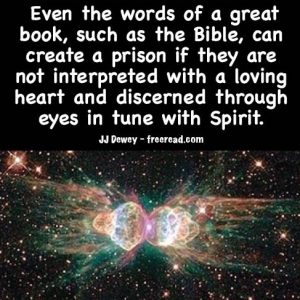
No one can read the scriptures with a black and white interpretation and understand them. All writings of great teachers can only be understood through the Holy Spirit and the principle of revelation.

Copyright by J J Dewey

Nov 18, 2001

Index for Older Archives

Index for Recent Posts

Easy Access to All the Writings

Register at Freeread Here

Log on to Freeread Here

For Free Book go HERE and other books HERE

JJ’s Amazon page HERE

Gather with JJ on Facebook HERE